Set of Mid Century Brass Cups by Harald Buchrucker
Set of Mid Century Brass Cups by Harald Buchrucker
Set of six, five cm tall brass cups with cane-wrapped ring handles, stamped with Harald Buchrucker's hourglass workshop mark. West Germany, mid-20th century.
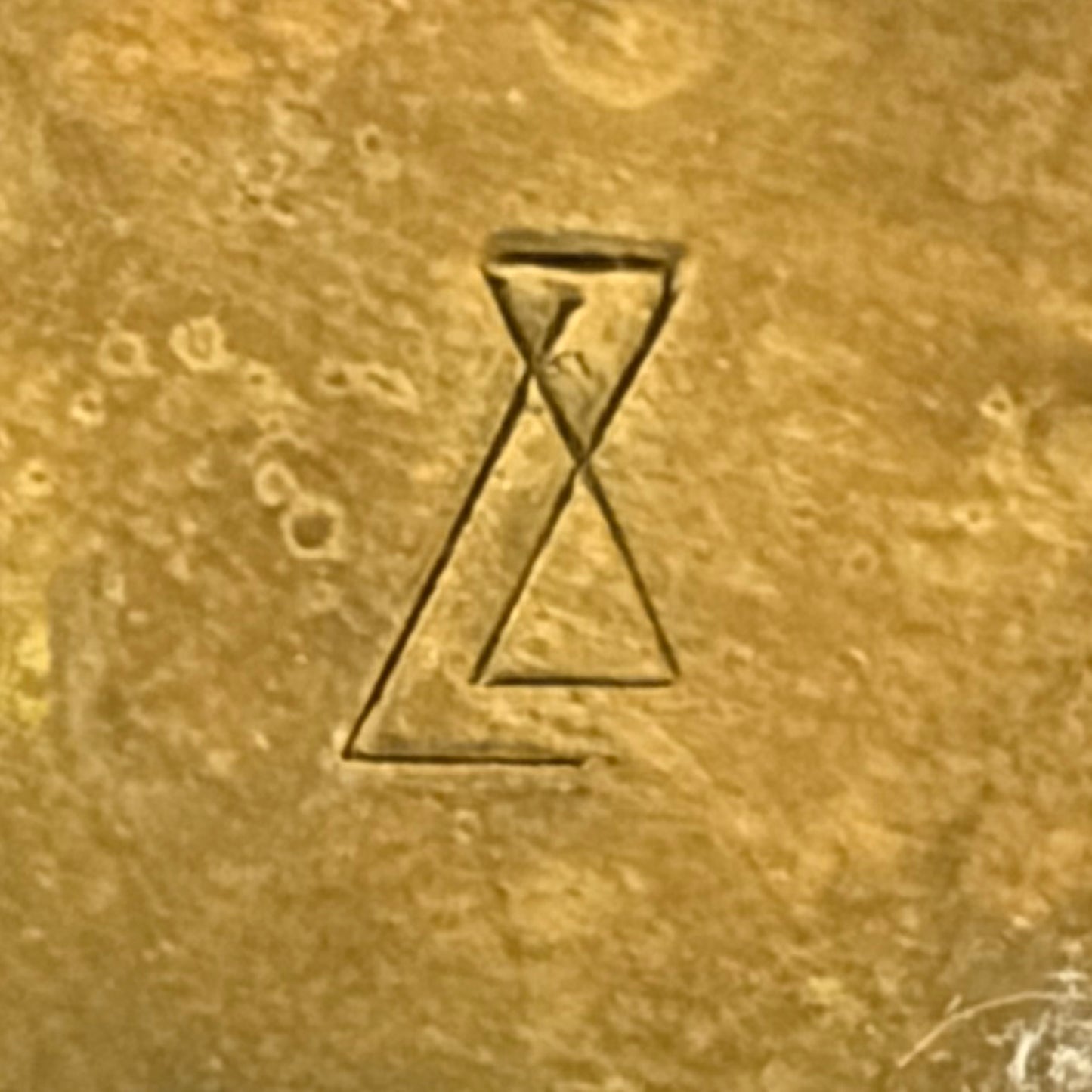
A small, weighty brass cup from the metalworking studio of Harald Buchrucker — one of five from a set, sold here individually. Spun brass, tapered like a straight-sided beaker, with a woven cane handle bent into a simple ring and pinned to the body with a brass rivet. The base carries Buchrucker's maker's mark, the distinctive hourglass-and-cross monogram he stamped into his workshop's output for decades.
The surface has the warm, uneven patina brass takes on after seventy-odd years of handling — deeper gold in the recesses, brighter where hands and light have worn it smooth. No lacquer, no polish beyond a light clean; the tarnish is original and part of the object's history. The cane handle shows honest wear consistent with age and use.
Likely intended for schnapps, akvavit, or strong coffee — small enough for a single measure, sturdy enough for daily use. Equally at home holding toothpicks, matches, or a few stems on a shelf.
Details
Height: 5 cm
Material: brass with cane-wrapped handle
Maker's mark: Harald Buchrucker hourglass monogram, stamped to base
Origin: West Germany, mid-20th century
Condition: good vintage condition with natural age patina and light surface wear; sold individually, part of a larger set
Sold as-is; patina is not polished off
About Harald Buchrucker
Harald Buchrucker (1897–1985) trained as an architect before turning to metalwork, and ran his own workshop in Germany from the 1920s through the 1960s. Working mostly in copper, brass, and pewter, he built a reputation for tableware that stripped ornament down to clean, functional form — jugs, coffee and tea sets, trays, candlesticks, and cups defined by simple geometric bodies, hand-hammered or spun surfaces, and handles bound in cane, bast, or wicker rather than cast metal. That combination of an architect's discipline with a craftsman's material warmth places his work close to the Bauhaus-era functionalist tradition, though executed with a softer, more domestic touch. Pieces from his workshop are typically identified by the small hourglass-shaped maker's mark stamped into the base or foot, as seen on this cup.
Buchrucker founded his own workshop in Ludwigsburg in January 1931, initially called Schwäbische Zinn- und Silberschmiede (Swabian Pewter and Silversmiths), working with support from artist Wilhelm Blutbacher of the Stuttgart Secession. It specialized in hand-hammered pewter and metalware made using a technique adapted from Danish silversmithing, and gained recognition quickly — showing at the Leipzig Trade Fair within two months of founding, and at the well-known Grassimesse in Leipzig from autumn 1931 onward. In 1954, the company was renamed simply Harald Buchrucker, and later became Harald Buchrucker GmbH & Co. It operated continuously in Ludwigsburg from 1931 until 1985 — the year Buchrucker died.
Couldn't load pickup availability
Share